Why More Training Is Killing Your Results
Why More Training Is Killing Your Results
Table of Contents
The Misconception About When the Body Changes
Why Pain Isn’t the Goal
Cardio With Weights and Overcomplication
Rest and Nutrition Build Muscle
When Goals and Actions Don’t Match
The Running and Fasting Problem
Why Recovery Determines Results
Why I Train Three Times Per Week
The Truth About Intermittent Fasting
What Is Periodization?
How to Align Your Training With Your Goals
Final Thoughts
The Misconception About When the Body Changes
Something I didn’t understand early on in fitness was when the body actually changed during the whole process. What I, and most others, think is you put in the work and then the body just does its thing. But also, you had to feel that burning sensation during the work and endure near-crippling soreness afterward to show any sort of improvement. Looking back on that, I realize how wrong I was and can appreciate why so many people don’t even want to try if it means that much pain.
Why Pain Isn’t the Goal
There are a couple truths to unpack there. One being that we are hardwired to find the easiest path forward and avoid pain. The other is that there is very little pain necessary to build your desired body. Effort, yes, but not that miserable pain that makes you want to puke during the process and then makes it nearly impossible to sit down or open the fridge the next day.
Cardio With Weights and Overcomplication
What grows the body is moving weights at a slow and controlled tempo. There are multiple techniques here, but none of which have you sweating puddles and experiencing a stinging sensation of lactic acid rushing to a body part. I call this cardio with weights, and it just overcomplicates and lengthens the road to a fit aesthetic.
Rest and Nutrition Build Muscle
The real focus I want to get to, though, is not the delayed onset of muscle soreness (DOMS) that builds muscle, but rest and nutrition. This is a case I just came across the other day. Someone I knew was complaining about how hard it is to put on muscle and lose fat when we get older.
When Goals and Actions Don’t Match
It was a couple weeks after he made that initial observation that I got a glimpse into what he was actually doing for fitness and nutrition. He was already overdoing it in the gym but was now adding a ton of running and only eating one hour a day. Yet his goal was to slim down the waistline, put on muscle, and run 8 to 10 miles most days.
More doesn’t mean better. There was a large gap between his goals and what was actually happening.
The two biggest things antagonistic to his muscle growth were not his age, but that the days his body would want to grow muscle were days he was training his body to pare it down while not giving it enough nutrients to grow in the first place.
It’s like throwing grease on the tires of a race car and only filling the tank a quarter of the way. It’s not going to get any traction, and it’s just going to putter out well before it could fishtail to the finish line.
Why Recovery Determines Results
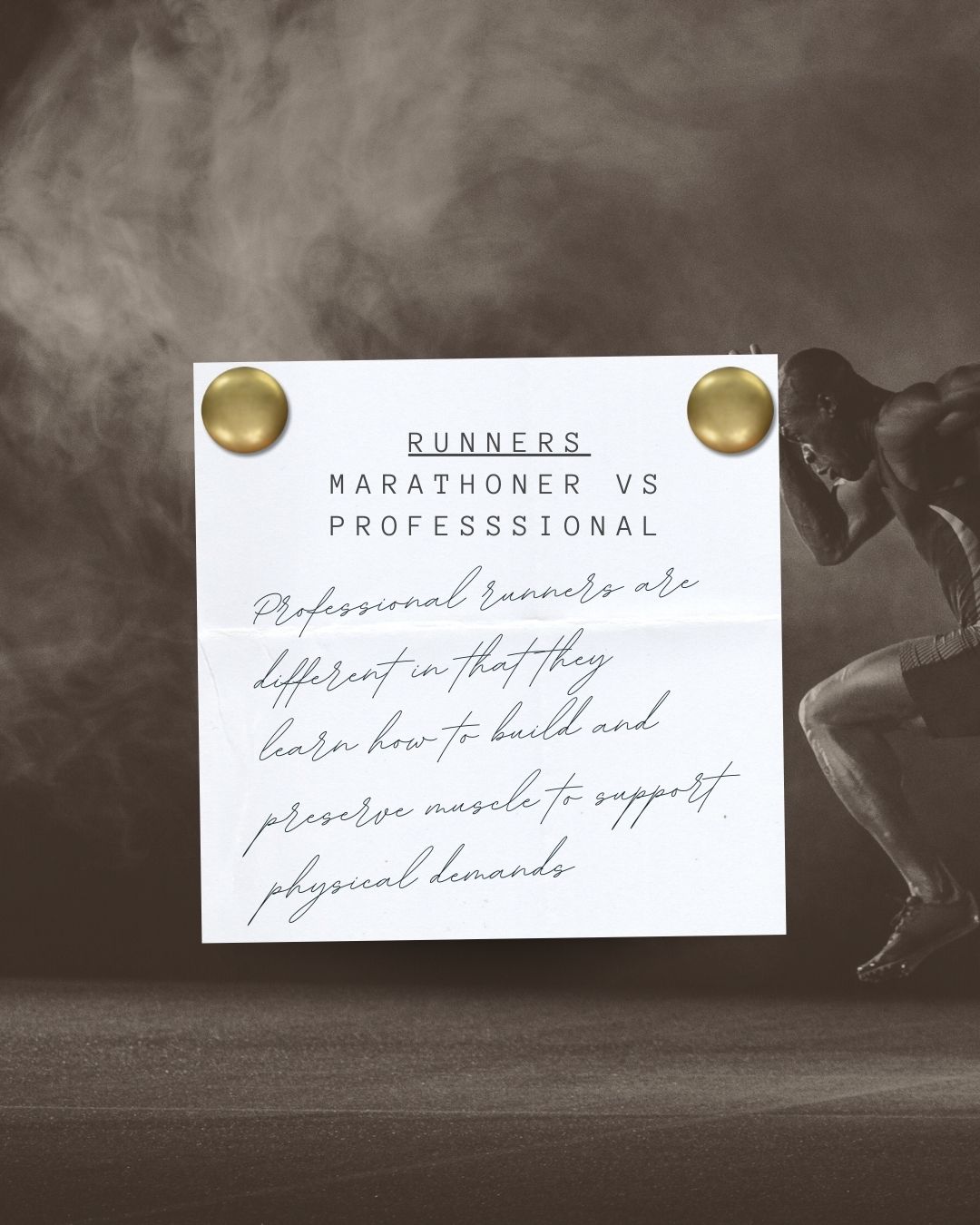
This is why there can be such a big physical difference between how a marathon runner looks versus an athlete who competes in professional races. The former can look malnourished while the latter is lean yet muscular. It all comes down to training and nutrition, and yes, genetics helps too, but only to a point.
Training has to revolve around rest and recovery. If not, that’s how our runner friends are constantly getting injured or still end up with major physical ailments despite how “healthy” people think they’re being.
Why I Train Three Times Per Week
This is why I only train three times a week in the gym. It’s full body, so I go every other day. My muscles are building on the days in between. I also don’t restrict myself to a feeding window. Even at my size, with a goal of 125g a day of protein, there is no possible way I can get that amount of quality protein in my body in just an hour without wanting to throw up.
The Truth About Intermittent Fasting
In fact, I’ve never been able to do that using any ratio of intermittent fasting, which is also why I don’t put clients on restrictive eating windows. It’s not a magic fat loss tool that the media has overhyped. It’s just less time to eat a large amount of calories. You know what else makes you eat less? A lot of protein, so I have people eat that first before their carbs.
Anyway, you can see why the guy was having a hard time. Muscles cannot build if there’s not enough protein to build from and time to grow. So what do you do?
What Is Periodization?
Figure out what’s most important, and then support that first. You can still do the other things, but this is where we use periodization. Think Taylor Swift’s Eras Tour. It showcased a different era throughout her career so far. Periodization is similar in that there are months of focus on one area at a time throughout the year, so by the end of the year you are actually hitting your goals.
How to Align Your Training With Your Goals
For him, I recommended that winter become prime muscle-building time. He would pare back the running and be gym-focused so he could build fat-burning muscle. Then, in the warmer months, he’d focus on running, which he loves to do. Instead of being in the gym four days a week, he’d want to do just two days a week of full-body exercises, maybe even just one day. The point isn’t to give up strength training altogether. He needs that to preserve joint health and support his running, but to realize that’s not the time muscle will be growing.
Final Thoughts
In summary, for anyone training hard and feeling like they’re not getting anywhere, stop trying to do more. Instead, rest and fuel up. You’ll be surprised how much it helps.
Simple Action Steps (Today!)
1. Choose Your Primary Goal
Muscle growth or endurance. Pick one as the main focus.
2. Support It With Recovery
Train every other day for muscle growth.
3. Eat Enough Protein
Prioritize protein before carbs.
4. Stop Adding More
If progress has stalled, reduce instead of increase.
FAQ
Does muscle grow during workouts?
No. Muscle grows during recovery when protein and rest are adequate.
Is soreness required for growth?
No. Soreness is not an indicator of progress.
Can you build muscle while running high mileage?
It is difficult because endurance training signals the body to become more efficient and lighter.
Is intermittent fasting good for muscle gain?
It can make it harder to hit adequate protein and calorie targets for growth.
What is periodization?
Strategically focusing on one training goal at a time throughout the year.
What's Next
If you’re tired of feeling overwhelmed by health advice, fitness programs, and lifestyle content, start with simplicity.
Choose one small habit today. Commit to it for a week.
If you want help building a system that supports consistency without burnout, join me inside M.O.V.E. Studio. It’s designed to feel calm, grounded, and actionable so you can build health that actually fits your life.
Simple. Sustainable. Repeatable.
That’s where real change begins.
